Power is becoming a product line.
On September 2, Vertiv announced an agreement to acquire UtilityInnovation Group (UIG), a Raleigh, North Carolina company that designs microgrid controls and behind-the-meter power architecture for AI data centers. Vertiv will pay approximately $1.45 billion in cash at closing, with up to $1.15 billion more in cash tied to UIG hitting EBITDA targets over 12 and 24 month periods.
That is a large price for a company founded in 2020. The strategic logic behind it is bigger still. Vertiv already supplies much of the power and cooling equipment inside AI data centers. Now it is reaching past the building toward the utility interconnect, betting that the fastest route to new capacity will increasingly run through a site’s own power system.
For developers, operators, investors and utilities, the deal shows where the industry thinks the next bottleneck sits, and who expects to profit from solving it.
Speed to Power Has Become the Metric That Counts
Vertiv CEO Gio Albertazzi put the rationale plainly: “For AI data center operators, competitive advantage increasingly depends on how quickly they can move from site selection to first token.”
That framing matters.
For most of the data center industry’s history, the critical path ran through land, construction and equipment delivery. In the AI buildout, many developers have the land, the capital, the customers and the chips lined up, and then wait on utility power. Microgrid Knowledge described the transaction as a way to help data center customers speed up deployment and bypass lengthy grid interconnection queues.
Vertiv’s own description of the expected customer benefits is telling. It promises faster access to power with less dependence on utility timelines, the ability to scale a site beyond what the grid alone can supply, and a single point of accountability from the grid connection through to the rack.
In other words, the constraint has moved outside the data hall, and the supply chain is moving with it.
What Vertiv Is Actually Buying
UIG is not a generation company. Its value lies in the layer that decides how multiple power sources work together at a site. According to Vertiv, the acquisition adds:
- Microgrid controls built on a proprietary software platform
- Orchestration of onsite generation and energy storage in real time
- Pre-engineered, microgrid-specific switchgear
- Behind-the-meter power architecture design from the earliest project stages
- Experience delivering microgrid systems for AI data centers in the U.S. and Europe
- Established relationships with utilities
UIG also brings manufacturing in North Carolina and New Jersey and a European base in Dublin. Founder and CEO Sidney Hinton said the company “was founded to solve increasingly complex power challenges for data center operators through flexible, technology-agnostic architectures.”
The words “technology-agnostic” carry weight. Operators are assembling power from gas turbines, reciprocating engines, batteries, fuel cells and the grid, often in combinations that change over a project’s life. The company that controls how those pieces fit together holds a strong position regardless of which generation technology wins.
Three Site Models, One Architecture
Vertiv says UIG’s expertise allows it to offer pre-validated reference designs for three types of site: grid-connected, bridge-to-grid and islanded.
Each reflects a real choice developers now face.
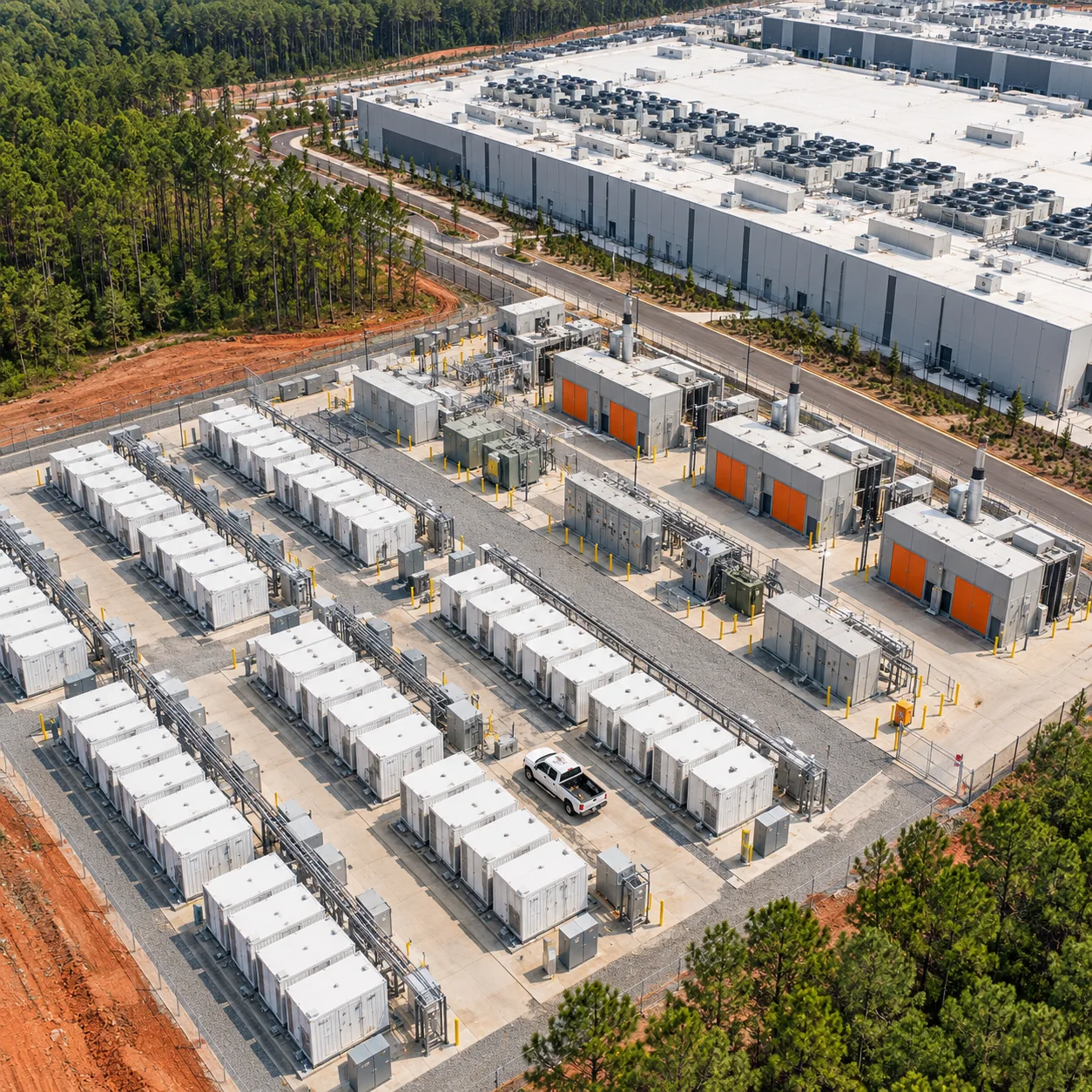
Grid-connected sites still draw primarily on the utility but can use onsite resources to add capacity or flexibility. Bridge-to-grid sites run on onsite power while waiting for the interconnection to arrive, then shift toward the grid. Islanded sites operate independently of the grid altogether.
Few campuses will stay in one category for their whole life. A site may start islanded, become a bridge-to-grid project when a transmission upgrade is finished, and end as a grid-connected facility with onsite generation for resilience.
Can the power system be designed once and adapted as the site evolves?
Can one supplier stand behind the whole chain from source to chip?
Vertiv is betting the answer to both should be yes, and says the combined architecture will run “from source to chip without tying customers to a single generation technology or supplier.”
The Price Tells Investors Where Value Is Moving
Vertiv says the upfront price represents approximately 13 times UIG’s expected 2027 EBITDA, and expects the deal to add to adjusted earnings per share in the first year after it closes. Including the full earnout, Microgrid Knowledge puts the total value of the transaction at approximately $2.6 billion.
The structure is instructive. Paying a substantial share of the price through performance targets ties the outcome to how quickly microgrid demand converts into delivered projects.
For investors, the broader signal is that value in AI infrastructure is spreading beyond chips and buildings into the engineering and control systems that make power available sooner. Controls software, switchgear and integration expertise used to be a niche specialty. They are becoming strategic assets for equipment makers that want to own more of the project.
Utilities Remain Part of the Answer
Behind-the-meter power is sometimes framed as a way around utilities. The reality is more cooperative than that.
Vertiv highlighted UIG’s utility relationships as a core part of the deal, and two of the three site models it describes end up connected to the grid. A bridge-to-grid campus is a future utility customer that has started operating early. A grid-connected campus with flexible onsite resources can be easier for a utility to serve during peak periods.
For developers, the practical lesson is to bring power architecture into site planning at the start, not after the interconnection study comes back. For utilities, well-designed microgrids offer a way to connect large loads in stages while transmission and generation catch up.
The transaction is expected to close in the fourth quarter of 2026, subject to regulatory approvals. The real test will come after that, in how many campuses reach first token sooner because their power systems were planned as a whole.
The grid will remain the backbone of AI infrastructure. The sites that win the race will be the ones that can bring their own power until the grid arrives.