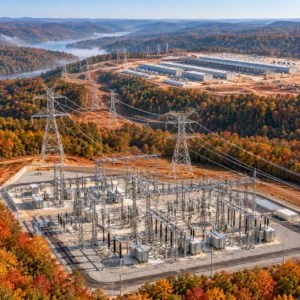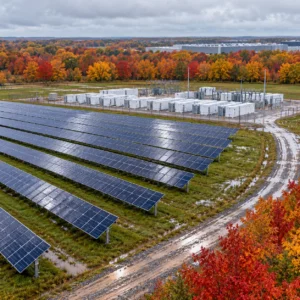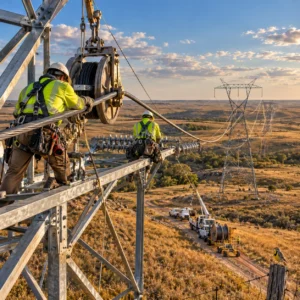
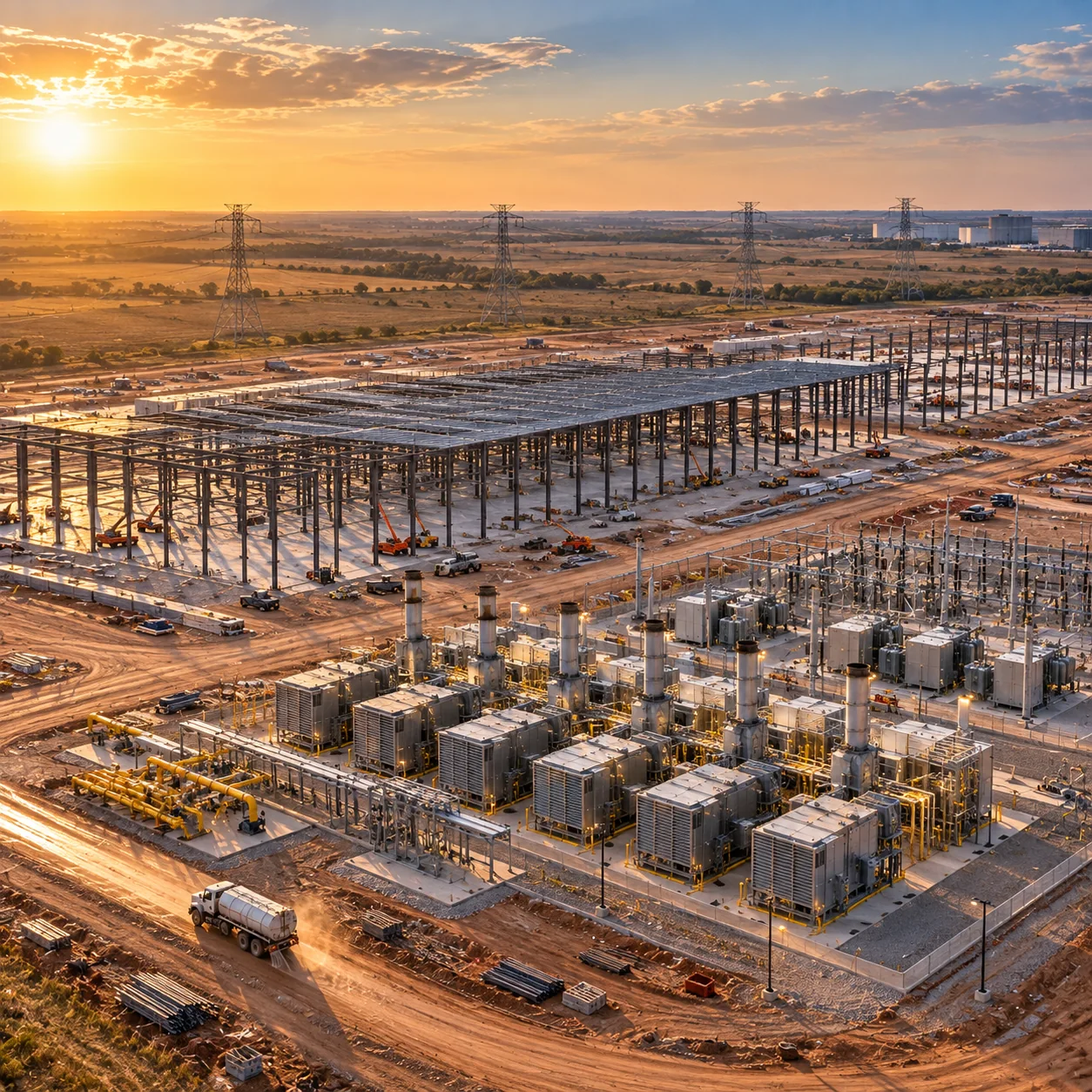
Power is now part of the site plan.
On October 13, Big Watt Digital and PowerHouse Data Centers announced that the development agreement for the Taylor Technology Campus had been approved. The Taylor City Council voted 5 to 0 at its October 8 meeting to back the agreement for the 664 acre site east of the city, between FM 112 and U.S. 79, according to CBS Austin.
The campus has the potential to support up to 1 GW of hyperscale data center capacity, according to W.Media. It will run on dedicated, behind-the-meter natural gas generation, with power availability targeted for the first half of 2028.
The project matters less for its size than for how it is put together. It shows a template for large AI campuses in Texas: generate power on site, write local standards into a binding agreement, and fund the community infrastructure up front.
Behind-the-Meter Generation Moves to the Center of the Plan
Grid capacity is the scarce resource in Texas. W.Media reports that ERCOT is tracking 438,000 MW of large load requests, nearly 89 percent of them from data centers.
Against that queue, a campus that brings its own generation can set a schedule around equipment delivery rather than an interconnection study. The Taylor site has access to fiber, high voltage transmission and natural gas, according to CRE Daily, which makes on-site generation practical. BlackRidge Research reports that the campus can also sell surplus power to the grid.
That combination matters.
A behind-the-meter plant with a grid connection can protect the data center load while giving the wider system access to extra supply when it is available. For developers, it turns power from a waiting game into a project management problem.
A Development Agreement Built Around Local Concerns
The site sits in unincorporated Williamson County. Council members and city staff said that without the agreement the city would have no authority over the project, KUT reports. With it, Taylor gains tools over water use, noise and air quality.
The terms summarised by BlackRidge Research are specific:
- Closed-loop cooling using reclaimed water, with an initial fill of 1.575 million gallons
- No potable water for filling HVAC systems or evaporative cooling, outside narrow exceptions
- A noise cap at the greater of 65 dBA or the pre-development level, against a state limit of 85 dBA
- Building setbacks of 300 feet, rising to 700 feet for data centers, power generation and battery storage on the south line
- A permanent planted buffer of at least 400 feet near FM 112, with earthen berms at least 6 feet high
- Wastewater upgrades that cut discharges to Mustang Creek
Those details answer the questions residents raised during months of debate over water and industrial growth. They also give other Texas cities a ready-made checklist for negotiating with large campus developers.
Community Commitments Arrive Before the First Building
The developers plan about $28.2 million in local commitments, including more than $10 million for Taylor ISD and local students, according to KUT. CRE Daily reports the money will also support scholarships, workforce training and nonprofits.
City officials estimate about $1.38 billion in gross tax revenue over 20 years, CBS Austin reports. The developers project $4.8 billion in economic impact and up to 19,000 full-time construction jobs across Williamson County, according to CRE Daily.
In a statement quoted by KUT, the developers said, “We also understand that being a responsible developer includes being a good neighbor and community partner.” Taylor ISD Superintendent Jennifer Garcia-Edwardsen backed the deal, telling the council, “We believe this agreement clearly meets that standard.”
Central Texas Is Becoming an Infrastructure Corridor
The campus sits near Samsung’s $17 billion semiconductor plant, which CRE Daily identifies as a major driver of growth around Taylor. Chip fabrication and AI compute on the same stretch of highway is a strong signal about where the Austin metro is heading.
The developers also have scale behind them. CRE Daily reports a combined 12 GW in active development and more than 24 GW in pipelines nationwide. Big Watt has construction underway on more than 2 GW across Texas and South Dakota, while PowerHouse has about 10 GW across nine markets, including a 1.8 GW project in Grand Prairie with Provident Data Centers.
For hyperscale tenants, that depth reduces the risk of committing to a single site. For investors, it points to developers that can repeat a model rather than invent one each time.
The Schedule Now Belongs to Construction
CRE Daily reports construction is slated for 2027 to 2029, with groundbreaking expected in 2027 and first power targeted for 2028. The next markers are generation equipment orders, a confirmed tenant and the first buildings rising on the site.
Approval settled who sets the rules in Taylor.
The grid could not set the pace. The campus will set its own.