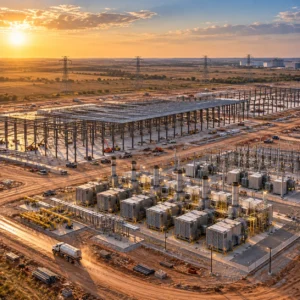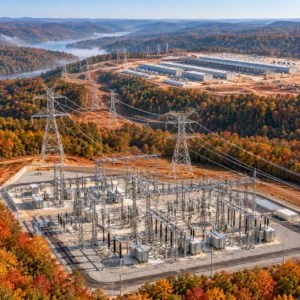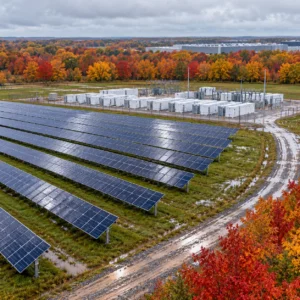
The fastest new transmission line may be the one already standing.
On September 24, the US Department of Energy selected 31 grid-improvement projects across 26 states under its SPARK initiative, short for Speed to Power through Accelerated Reconductoring and other Key Advanced Transmission Technology Upgrades. The federal share is $1.9 billion. Add $3.35 billion in recipient cost share and the total package reaches $5.25 billion.
According to DOE, the selected projects will reconductor or rebuild more than 1,500 miles of transmission lines, deploy grid-enhancing technologies across nearly 21,000 miles and make more than 23 gigawatts of additional electricity capacity available.
For data center developers stuck in interconnection queues, that is the number that matters.
Speed to Power Has Become Federal Grid Policy
The program’s name says what it is for. SPARK is built around the gap between how quickly new electricity demand is arriving and how slowly the grid has historically expanded to meet it.
Energy Secretary Chris Wright framed the selections around existing assets, saying the investments will get more out of the infrastructure the country already has, move more electricity across the grid, and help deliver affordable, reliable, and secure power. DOE’s program documentation also names “transmission systems that facilitate development of new large loads” as an area of focus.
The pressure behind that language is easy to measure. Moody’s analysis expects US data center electricity consumption to nearly double between 2025 and 2030, reaching 426 TWh a year. Quartz reports that data center electricity use already jumped 80% between 2020 and 2025.
Load is arriving on a software timeline.
Transmission has been arriving on a generational one.
Reconductoring Turns Old Corridors Into New Capacity
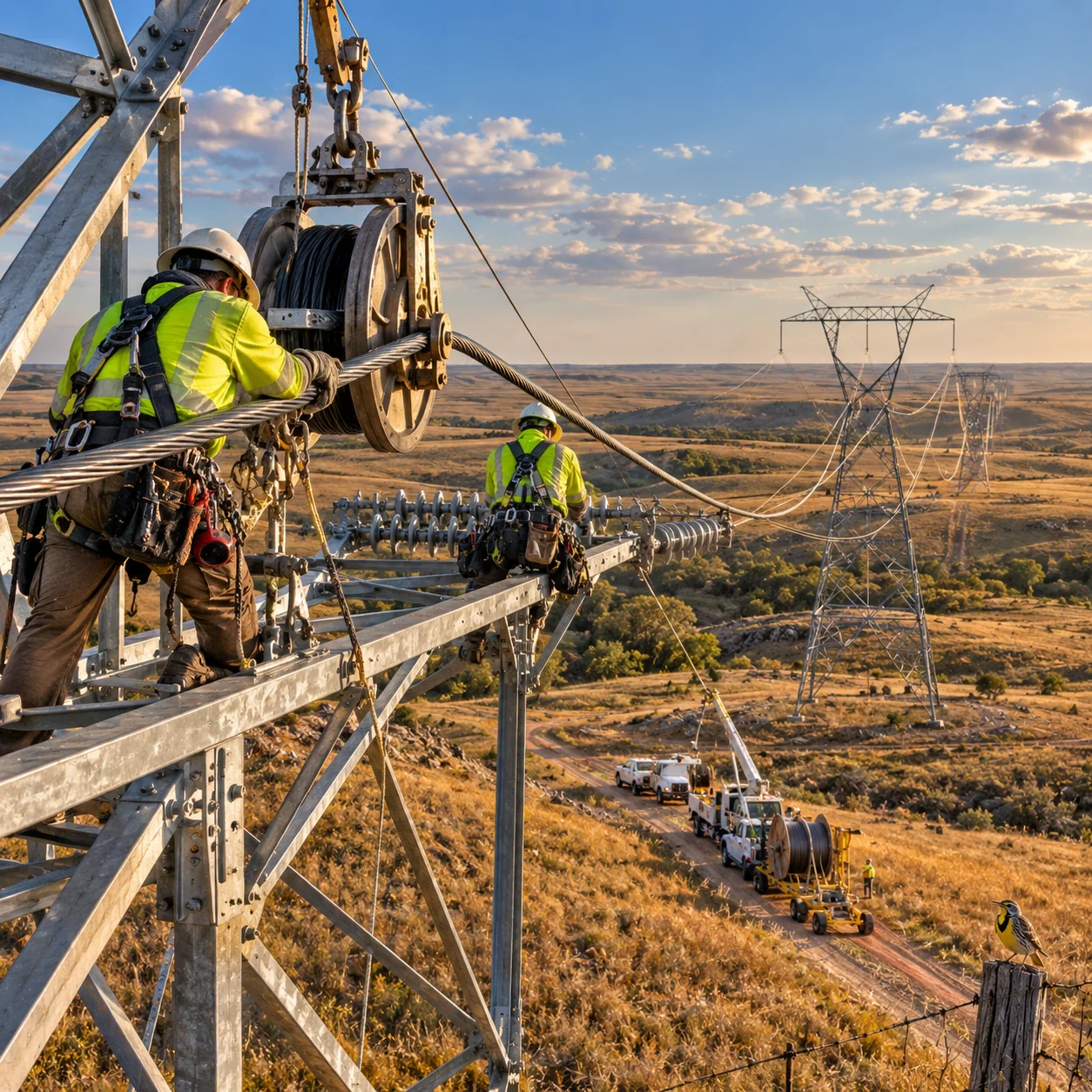
Reconductoring replaces the wires on existing towers with advanced conductors that can carry more current. Grid-enhancing technologies add sensing and power flow control, so operators can safely push more power through lines that were previously run conservatively.
DOE says this approach bypasses the multi-decade timelines typically required to build new transmission corridors. The rights-of-way are already secured. The towers are already standing. The communities along the route already live with the line.
That change matters.
A greenfield corridor has to win siting approval, land rights and environmental review before construction starts. An upgrade inside an existing corridor avoids much of that exposure. For a hyperscaler or colocation developer, the difference shows up as the date power reaches the substation.
DOE’s Office of Electricity Assistant Secretary Catherine Jereza said the projects would “unlock more than 20 gigawatts of additional grid capacity” through modernized transmission technologies. For comparison, that is the scale of many gigawatt-class AI campuses combined, delivered largely through hardware swaps rather than new routes.
The Selections Reach Into Growing Load Centers
Several of the selected projects sit in regions where large-load demand is already shaping grid planning.
In Ohio, $216 million will help AEP upgrade three sections of the 345-kV Kammer-Muskingum Corridor and the Beatty-Cole line with advanced conductors, according to Daily Energy Insider. In Indiana, roughly $175 million targets congestion at the seam between PJM and MISO, two grid operators where interconnection queues have become central to data center siting decisions. An Indiana official quoted in the announcement put it directly: the state “must meet the power needs of the businesses making those investments.”
Other selections focus on moving power between regions. Colorado will receive $250 million to help Xcel Energy upgrade the aging Lamar Tie connecting the Western and Eastern grids. Utility Dive also highlights the Three Corners Connector, an $832 million Grid United project linking the Southwest Power Pool in Oklahoma with the Western Electricity Coordinating Council in Colorado.
Utilities named among the selections include Alabama Power, Duke Energy Carolinas, Eversource Energy, Kit Carson Electric Cooperative and PPL Electric.
Interregional capacity may prove as valuable as local upgrades. A data center campus in a constrained zone benefits when cheaper or surplus generation elsewhere can actually reach it.
What Developers and Utilities Should Watch Next
These are selections, not final awards. DOE expects to finalize awards between October 2026 and January 2027, with funding drawn from the Infrastructure Investment and Jobs Act. That leaves several questions for anyone planning large loads near the selected corridors:
- Which upgraded lines sit near planned or queued campuses
- How utilities allocate freed capacity among competing large-load requests
- Whether new headroom shortens interconnection studies or only reduces congestion
- How the $3.35 billion in recipient cost share is treated in rates
- How outages are scheduled while lines are rebuilt
- Whether successful projects become a template for utility capital plans
For developers, the practical step is to map site pipelines against the selected corridors and engage utilities early. Capacity created by an upgrade does not automatically go to the first data center that asks for it.
For utilities, SPARK offers a way to answer large-load requests without asking regulators to approve an entirely new corridor first.
Existing Infrastructure Is Becoming the First Source of New Capacity
SPARK fits a broader pattern in how the US is meeting AI-driven demand: get more out of what already exists before building something new. Uprates at operating power plants, restarts of retired units and now high-capacity conductors on old towers all follow the same logic.
The approach also helps with affordability, which has become harder for the data center industry to ignore. DOE says the selected projects will lower operating costs by easing congestion and avoiding expensive greenfield construction, benefiting roughly 100 million Americans. Grid upgrades that serve households and data centers at the same time are easier to defend at a public utility commission than capacity built for one customer.
Will 23 gigawatts close the gap between AI demand and grid supply?
No single program will.
What it does show is that transmission speed can improve without waiting a decade for a new right-of-way. That gives developers, utilities and investors a more realistic path to power in the regions where demand is growing fastest.
New generation gets the headlines. The wires decide when it reaches the load.