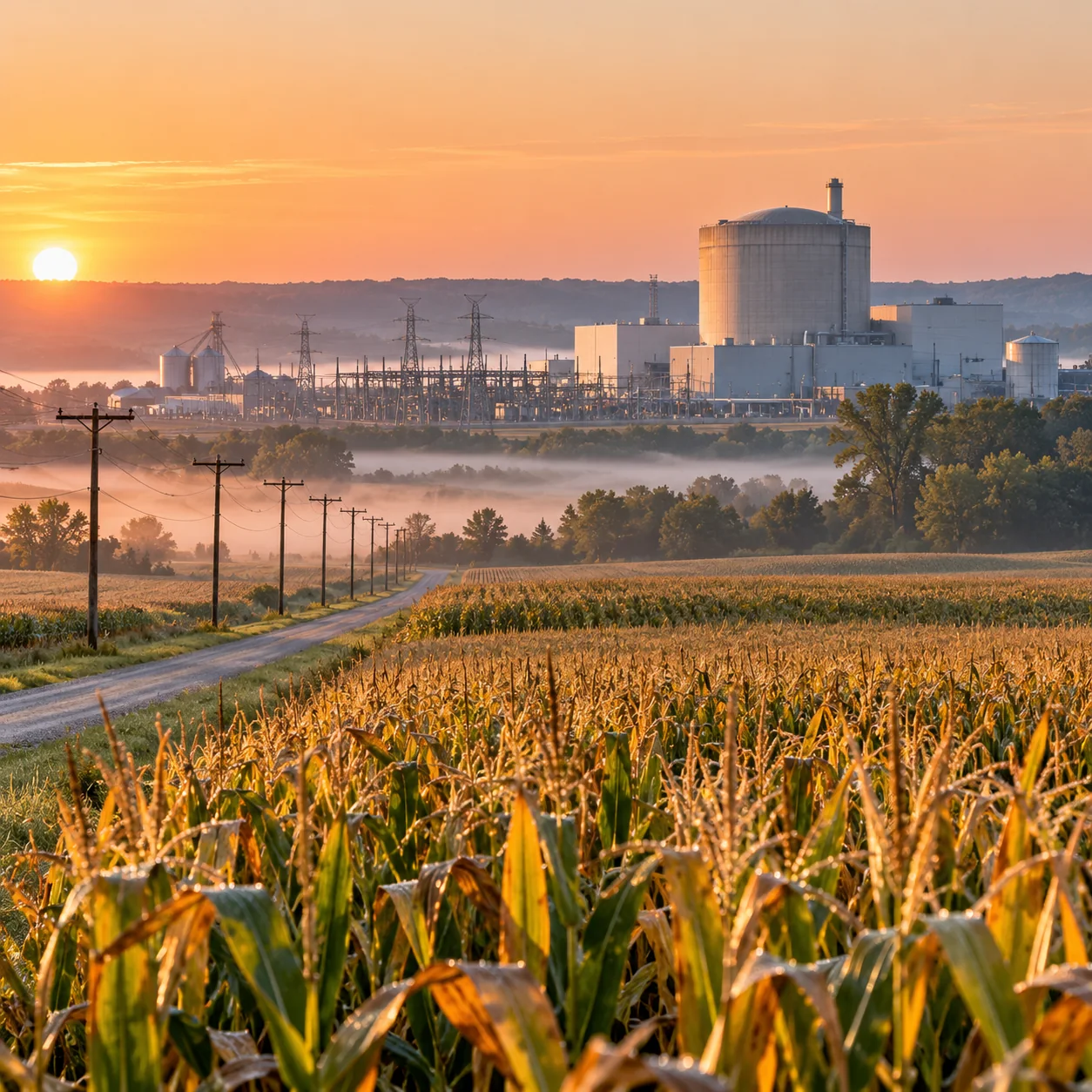
Iowa’s only nuclear plant is a step closer to running again.
On September 8, NextEra Energy and the U.S. Department of Energy’s Office of Energy Dominance Financing reached financial close on a loan of up to $1.9 billion to support the restart of the Duane Arnold Energy Center in Linn County, Iowa. The 615-megawatt boiling water reactor shut down in 2020 after more than four decades of operation. NextEra expects to return it to service no later than the first quarter of 2029, pending approvals from the U.S. Nuclear Regulatory Commission.
The anchor customer is Google, which signed a 25-year power purchase agreement with NextEra in October 2025 to supply its cloud and AI infrastructure in Iowa.
Put together, the deal shows how firm power for AI is starting to get built. A hyperscaler contract provides revenue certainty, a federal loan provides patient capital, and an existing site provides a grid connection that a new plant could wait years to secure.
Financial Close Turns a Restart Plan Into a Project
Nuclear restarts are easy to announce. Financing them is harder.
The October 2025 agreement with Google established demand. NextEra also signed a definitive agreement to take full ownership of the plant from its minority owners, according to ANS, with Central Iowa Power Cooperative, a nonprofit serving 300,000 Iowans, agreeing to buy the remaining output.
The regulatory work has also moved forward. ANS reports that NextEra filed a licensing change request with the NRC in January 2025, and in June 2026 the Iowa Utilities Commission issued a certificate authorizing construction and operation of the facility. According to NextEra, the NRC continues to oversee the extensive inspections and readiness activities that a restart requires.
Closing the loan removes one of the biggest remaining uncertainties.
“Returning 615 megawatts of reliable baseload generation will drive down electricity costs, while supporting thousands of American jobs,” said Deputy Secretary of Energy James P. Danly. NextEra chairman and CEO John Ketchum framed the project around demand: “Restarting Duane Arnold is about delivering new power to meet new demand while generating billions of dollars in economic value for Iowans.”
Existing Sites Offer the Fastest Firm Megawatts
For data center developers, the hardest thing to secure is often power that arrives on a predictable schedule. Interconnection queues are long, new transmission takes years, and new nuclear builds are measured in decades rather than quarters.
A retired reactor skips much of that. Duane Arnold already has a site, a licensing history, a trained regional workforce to draw on and a place on the Midcontinent Independent System Operator grid, according to DOE. Once restarted, it is expected to produce enough electricity for nearly 500,000 homes.
Speed is the product.
Duane Arnold is not alone. Utility Dive notes that Constellation is restarting the 835-MW Crane plant, formerly Three Mile Island Unit 1, at an estimated cost of $1.6 billion, and that DOE has now financed three nuclear plant restarts under the current administration. The pool of viable restart candidates is small, which makes each of these plants more valuable to the buyers competing for carbon-free baseload power.
Hyperscalers Are Paying for the Power They Use
Affordability has become the central political question around data center growth. The structure of this deal speaks directly to it.
When NextEra announced the restart, it guaranteed that Iowa energy customers would not bear any costs associated with the power Google buys from the plant, according to ANS. A DOE spokesperson told Utility Dive that “hyperscalers, not taxpayers, are paying for new power generation.”
For utilities and regulators facing pressure over large loads, that is a template worth studying. The buyer that creates the demand also underwrites the supply, and existing customers gain a source of firm generation they did not have to finance.
Several lessons carry over to other projects:
- Long-term offtake from a creditworthy buyer is what makes complex generation financeable.
- Federal lending can lower capital costs once contracted revenue is in place.
- Existing interconnection rights are a strategic asset and should be valued as one.
- Ratepayer protections written into contracts make regulatory approval easier.
- State support, from certificates to incentive legislation, shortens the path to construction.
- Delivery dates still depend on NRC licensing and skilled labor.
The Economic Case Extends Well Beyond the Plant
NextEra cites a study estimating that the restart could generate more than $9 billion in economic benefits for Iowa over 25 years, along with roughly $75 million in tax revenue over the life of the project. DOE estimates about 1,500 construction and refurbishment jobs and 462 permanent operations jobs.
The plant also supports Google’s existing footprint. At the time of the October 2025 announcement, ANS reported that Google had already invested more than $6.8 billion in Iowa data center development. Firm local power gives that investment a longer runway and strengthens Iowa’s case as a destination for future AI capacity.
Iowa Governor Kim Reynolds pointed to the state’s incentive legislation for nuclear development, a sign that states now see generation policy and data center recruitment as the same conversation.
Execution Will Decide How Far the Model Travels
The next milestones are practical ones: completing refurbishment, passing NRC inspections, securing licensing approvals and staffing a reactor that has been idle since 2020. A restart in early 2029 would put 615 MW of baseload power onto the MISO grid at a time when demand from data centers is still climbing.
NextEra is already thinking at a larger scale. Utility Dive reports the company is targeting 15 GW of new generation for large loads by 2035.
Restarts will not supply all of that. They do, however, show developers, investors and utilities how firm power for AI can be contracted, financed and permitted when every party carries its share.
Duane Arnold was built to serve the last century’s demand. Its second life is being paid for by this century’s.