Data centers do not have to be the least popular building in town.
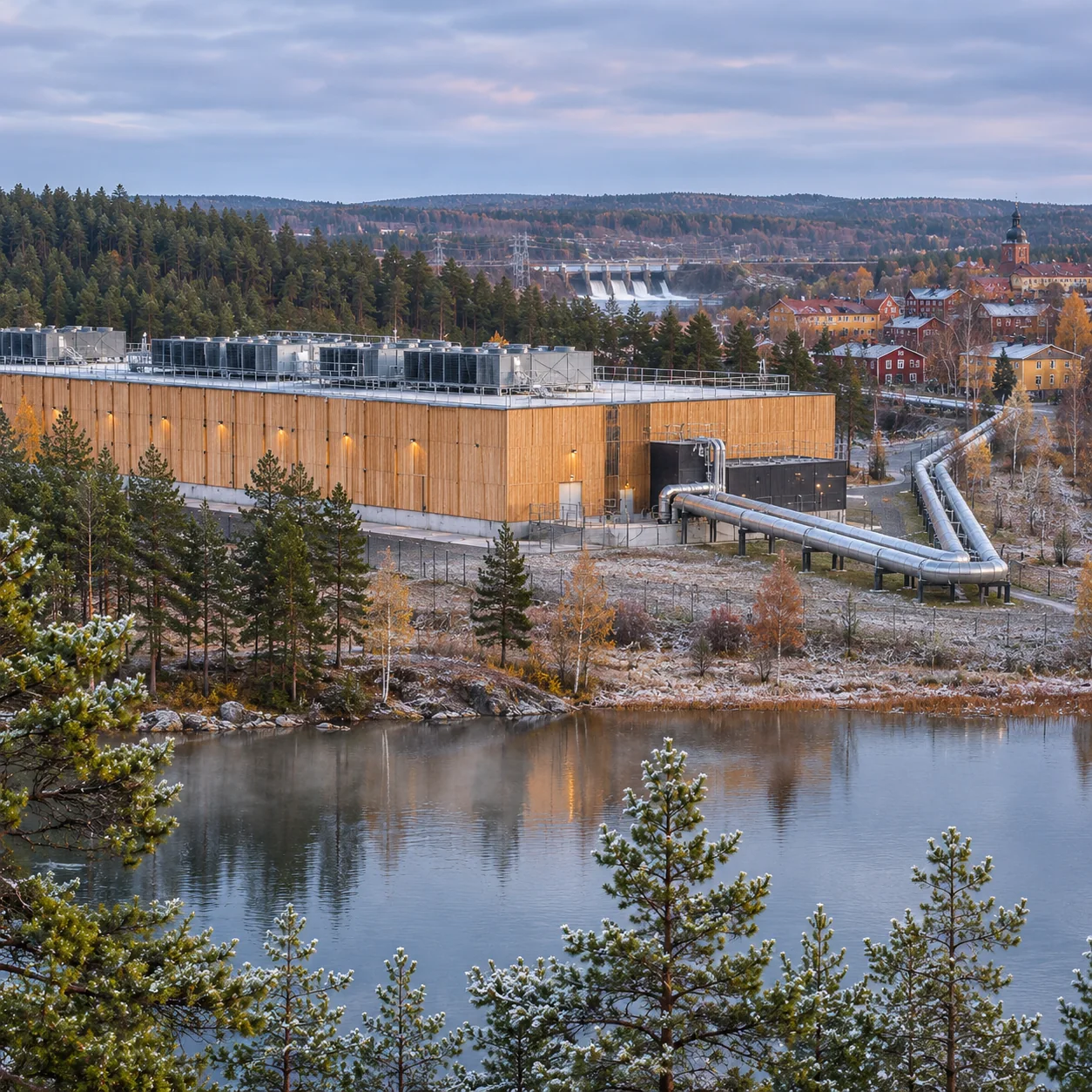
That is the lesson of EcoDataCenter’s campus in Falun, a former copper-mining town a few hours north of Stockholm. The facility was profiled by The Guardian on November 12, 2026, as a candidate for the greenest data center in the world, and the details explain why.
The structure is built from cross-laminated timber panels that arrived pre-cut and were craned into place. The power is 100% renewable, roughly three quarters hydroelectric and one quarter wind. The waste heat warms homes. And the project was started by the local municipality, not imposed on it.
For US developers facing growing local resistance to new AI campuses, that combination is worth studying closely.
The Numbers Behind a Low Carbon AI Campus
The Falun site has a capacity of 80 MW, enough electricity for about 60,000 homes, and around 70% of its computing power now serves AI workloads.
Its efficiency figures stand out. According to the company’s sustainability reporting cited by The Guardian, EcoDataCenter’s carbon usage effectiveness is 1.17 grams of CO2 per kWh, against a US data center average of 414 grams and an EU average of 263. Its power usage effectiveness is 1.15, compared with an EU average of 1.36, and both measures are improving year on year.
The timber frame matters too. EcoDataCenter says building in wood rather than steel and concrete cuts the embodied carbon of the structure to about a third, and that the timber in one of its facilities takes Swedish forests only 10 to 15 minutes to grow back.
Even the backup generators avoid fossil fuel. They run on hydrotreated vegetable oil, a biofuel made from waste oils and fats.
Cooling Is Designed Around Climate, Not Against It
Water use has become one of the sharpest points of friction for US projects. In Falun it is far less of an issue.
Outside air below about 20C is cold enough to cool the halls on most days, so on a cool, rainy day no water is needed at all. On warmer days, rooftop chillers use a fine water mist, drawn mostly from a nearby lake that once supplied drinking water.
The newest halls go further. Liquid cooling runs in a closed loop that draws no outside water, serving Nvidia Blackwell racks that each throw off heat equivalent to roughly 25 saunas. Those racks power DeepL’s AI translation platform, and declared customers also include CoreWeave, Mistral and the universities of Hull and York.
That customer list says something on its own.
Sustainability credentials are now part of how capacity gets sold, especially to AI firms with their own climate commitments.
Waste Heat Becomes a Product
The most transferable idea in Falun may be what happens to the heat.
Part of it dries wood pellets, a by-product of the local timber industry, at a pellet plant next door that was placed there deliberately. The rest, including heat captured by the liquid cooling, flows straight into Falun’s district heating network, which pipes hot water to homes and businesses across the town.
Stockholm shows the model at city scale. Stockholm Data Parks, a joint effort by the city and its energy, grid and fibre companies, connects around 20 data centers to the district heating system, recovering about 110 GWh of heat a year. At one 12 MW atNorth facility in Kista, the data center hands water at about 30C to the heating plant over the fence and takes cold water back for cooling.
Most US cities lack district heating at that scale. But the principle holds wherever a data center sits near a heat user, whether that is a greenhouse complex, a food processor, a campus loop or an industrial dryer.
Local Benefit Was Built In From the Start
The Falun project began with the municipality in 2010, years before the AI boom, and the question from day one was how a data center could fit the community. EcoDataCenter was formed in 2014 to deliver it, and the first phase opened in 2019.
The company says 90% of its suppliers are local and 60% of its capital spending stays in the area, and it funds education, training, sports and youth programs.
Its second campus, in nearby Borlange, takes the idea further. The 240 MW site occupies 200,000 square meters of a former paper mill that closed in 2021, reusing its grid connection, water supply and district heating links. The first phase is due in 2027, and the company expects it to employ 200 to 300 people, roughly the workforce the mill once had.
What US Developers Can Take From the Nordic Playbook
The US cannot copy Sweden’s grid, which draws only about 1% of its power from fossil fuels and took decades to build. Several parts of the model still translate directly:
- Brownfield sites such as closed mills and plants that already have grid, water and industrial zoning
- Partnerships that begin with the municipality before land is optioned
- Heat offtake agreements negotiated alongside the power contract
- Closed loop liquid cooling that removes water from the local debate
- Low carbon structures and backup fuels that cut embodied and standby emissions
- Local procurement targets that keep construction spending in the region
None of these require a Nordic climate. They require planning the campus as local infrastructure rather than as a sealed box.
Sweden did not make data centers popular by building fewer of them. It made them useful to the towns around them.